A race with 500 runners needs roughly 12 to 15 standard units plus at least one ADA unit under ADA Standards 213.2, spread across the start corral, mid-course aid stations and the finish line. San Clemente Porta Pros builds the layout around your route map, not a flat headcount.
Runner count drives the number, but so does course shape. A point-to-point course spreads people out over miles, so you cluster units at aid stations instead of one big bank at the start. A loop course lets you concentrate restrooms near the finish since runners pass it more than once. OSHA 1926.51(c) sets ratios for fixed worksites, but race organizers generally plan tighter than that because runners wont walk far mid-race. A rough guide: one standard unit per 40 to 50 participants at the start line, plus extras at any aid station past mile 4. For a 500-runner field in San Clemente, that lands near a dozen standard portable toilets with one or two ADA-accessible units at the start and finish both, since ADA Standards 213.2 calls for at least one accessible unit wherever units are clustered, and never fewer than 5 percent of the total. Spectator zones need their own count too. Families waiting near the finish line generate steady traffic for hours, so we usually add a bank of portable restrooms there separate from the runner supply. If your event draws a bigger crowd or overlaps with a festival component, look at our festival restroom planning for how vendor and crowd zones get handled differently than the race course itself.
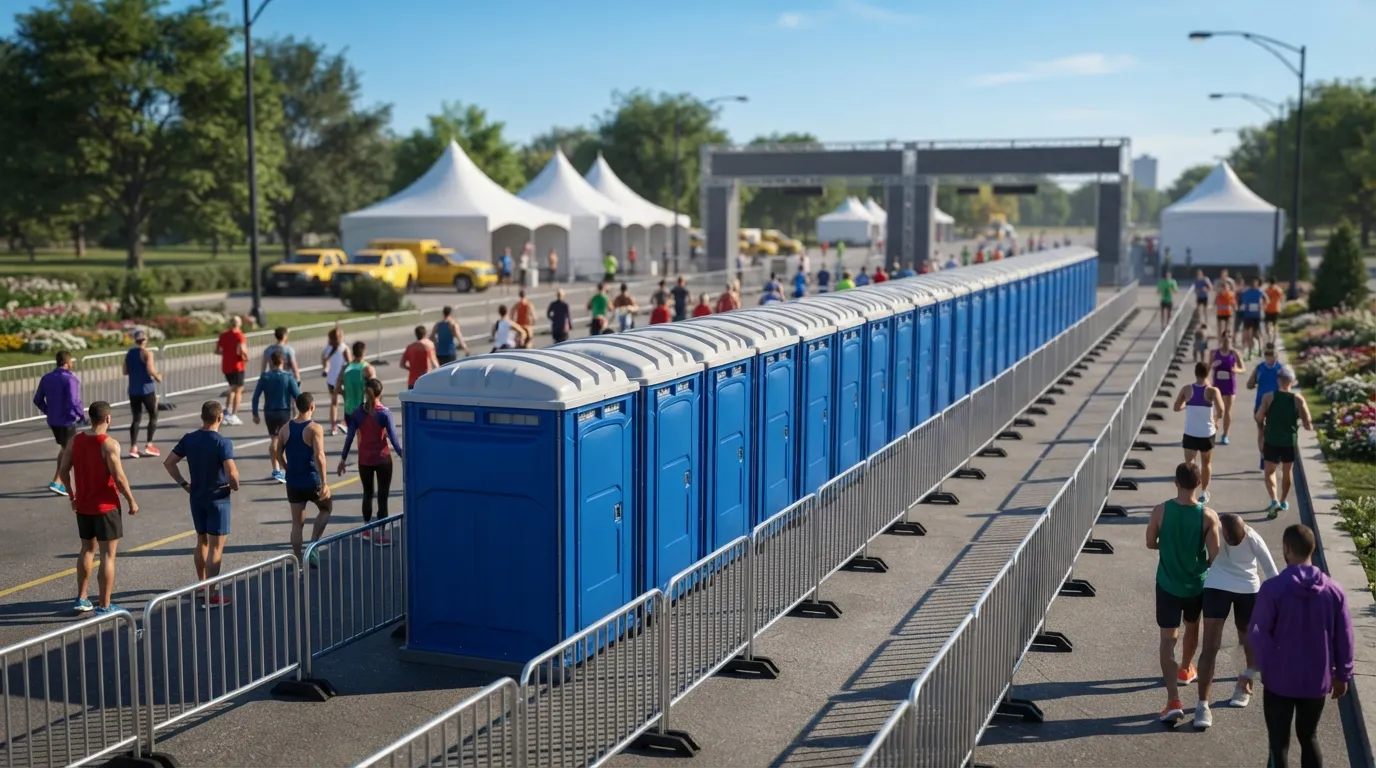
Placement matters more than raw count on a race course. Units belong at the start corral, every aid station past the first few miles, and the finish chute, but never blocking the running lane itself or a spectator sightline. A firm, level pad is required so units don't tip on turf or sand, since ADA Standards 302.1 calls for stable, slip-resistant ground at accessible units, and race organizers should hold that standard for every unit, not just the ADA ones. Access matters too. Our delivery trucks need clear approach room to set units at each station, similar to how a roll-off dumpster delivery needs about 60 feet of straight clearance behind the truck. Courses that run near Dana Point, 6.5 miles west of San Clemente, or up toward San Juan Capistrano, 7.6 miles northwest, sometimes stage restrooms at a shared aid point if the route crosses jurisdiction lines, so check with race organizers early. If your event runs a timing tent or announcer booth with electronics, you'll likely also need a temporary power pole at that station. Ground staff should know how to brace a temporary power pole against wind gusts common along the coast route, using guy wires anchored at three points and a stable base plate, since a toppled pole near a restroom bank is a hazard nobody wants on race morning. We coordinate pole and restroom placement together so cords never cross a runner lane.
Runners sweat, aid stations spill sports drink, and hands get sticky fast, so a handwashing station belongs next to every restroom cluster, not just at the finish. 29 CFR 1910.141(d)(2) requires soap and towels or a hand-drying device at washing facilities, and a sanitizer bottle alone doesn't satisfy that standard. We set handwashing stations or portable sinks at each aid station and double up near food and hydration tables. Post-race cleanup usually needs a roll-off dumpster for cups, gel packets and course signage, sized to your expected trash volume; a typical race generates enough waste that a 10 or 20 yard dumpster covers most single-day events. If the finish line area includes a beer garden or vendor row, ask about temporary fencing to route foot traffic around service areas and keep the restroom queue orderly. San Clemente events near the pier or beach trail often add fencing simply to keep casual beachgoers separate from the runner course, which also protects your restroom units from becoming public property mid-race. For multi-day events like a stage race or a combined marathon and expo weekend, our monthly rental and weekly options cost less per day than booking single days back to back, worth checking against our rental cost breakdown before you finalize a budget.
| Item | Day | Week | Event Rate |
|---|---|---|---|
| Standard unit | $100 - $350 | $130 - $500 | $200 - $800 |
| ADA unit | $200 - $400 | $240 - $400 | -- |
| Delivery fee | $100 - $500 | $150 - $250 | -- |
| Dumpster (10-20 yd) | $51 - $112 | $426 - $778 | -- |
Event-day rates for standard units run $200 to $800 depending on unit count and service frequency, since race weekends often need mid-event servicing that a construction site wouldn't. Ask about our event restroom packages if you're also planning a marathon-and-race weekend expo tent alongside the run.
Book as soon as your course map and expected field size are set, ideally 6 to 8 weeks out for a race over 300 runners. Popular race weekends fill delivery schedules fast, especially if other events in Rancho Santa Margarita, 16.0 miles north, or Aliso Viejo, 15.3 miles northwest, are competing for the same trucks.
Yes. ADA Standards 213.2 requires at least one accessible unit anywhere portable toilets are clustered, regardless of total field size. A 60 inch turning circle and 32 inch door clearance apply to that unit under the same standard.
We can reposition units between waves if access allows it, but course-day moves work best when planned in advance. Tell us your contingency plan for weather or route changes during initial booking so we can stage extra units nearby.
Most single-day races under 1,000 runners fit a 10 or 20 yard dumpster, depending on how much course signage and vendor waste you expect. Multi-day events or expos usually need a 30 yard unit instead.
Placement in the public right of way, along sidewalks or street closures, needs confirming with the city before race day. Check with race organizers and the city about your specific course permit, since requirements vary by route and street closure plan.
Yes. San Clemente Porta Pros delivers marathon and race restrooms across San Clemente and the surrounding metro, with same-day and next-day drop-off available on most orders.
Pricing depends on the unit and how long you need it. See our cost breakdown and request a free quote for an exact figure.
Standard rentals include scheduled service — a pump-out, a clean, a restock and fresh deodorizer. Busy or hot-weather sites can be serviced more often.
Call now or request a free quote — clean units, on-time delivery, transparent pricing.